
It isn’t uncommon for one of Take A Friend To Orchestra (TAFTO) month’s contributors to play a little hypothetical artistic programming in his/her essay and for most, that’s as far as the exercise goes. But Sir Andrew Davis is a member of the limited club of music professionals who enjoys that responsibility on a regular basis and his contribution shares some real life experiences bringing newbies to concerts as well as having a little “what-if?” programming fun…
Take A Friend To The Orchestra
By: Sir Andrew Davis
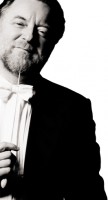
So I’m taking a classical-music neophyte-greenhorn-virgin to a concert – a prospect that’s both exhilarating and daunting. How do I know what he or she will take to, or like, and possibly even love? He or she certainly doesn’t.
When I was 18 and waiting to begin my first year at Cambridge University, I taught music to slightly younger teenagers, 12 to 16 years old, in a rough neighborhood school. I tried Bach, Beethoven, Tchaikovsky, and the like on them – all to no avail. What finally got them going, surprisingly enough, was Bartok.
Any such preliminary experimentation is obviously out in the present case, but might I deduce something from my teenaged pupils? Was the music represented – from the Classical and even Romantic periods – too far removed from their own lives? Could Baroque music fare any better? Perhaps.
I eventually got my kids – well, my fellow adolescents, really – jiving to the rhythmic propulsion and energy of Bach’s Brandenburg Concertos. They also quite liked Vivaldi – though personally I remember attending a concert many years ago (in Palermo!) whose first half consisted of three Vivaldi Flute Concertos, at the end of which I rushed out of the hall into the open air to scream. The Red Priest is not a particular favorite of mine!
But I digress.
So – for my novice concert companion should I choose musical works that are my favorites? I think we can assume a greater level of sophistication or at least open-mindedness in my companion than in those teenagers back in 1972. A couple of recent cases would seem to bear this out. Recently I conducted Richard Strauss’s Alpine Symphony at a young people’s concert in Frankfurt; at the stage door afterwards a nice fellow in his late teens told me in excellent English that this was his very first concert and he was hooked.
Last autumn (short season that it is in the Windy City), we performed Alban Berg’s Lulu at Lyric Opera of Chicago, and a friend of mine brought along a young man who had never been inside an opera house. He was bowled over by the experience and vowed to return often. We at Lyric were also astonished at the response to this seemingly challenging opera by college students who purchased tickets through a program called NExT, which offers discounted tickets throughout the opera house (not just the nosebleed seats, either!) to fulltime students who’ve registered online with the program. We send out an email blast whenever tickets are available for select performances; interested students can reserve, then pick up and pay for their tickets – just $20 – at their own special box office. The point being – the NExT student ticket demand for performances of Lulu was unprecedented.
So much for starting novices on Mozart or Puccini!
A few years ago, during our annual Operathon radio fundraiser, Lyric began offering a pair of tickets – highly sought after – to anyone who called in and swore that they had never attended an opera before. It was a huge success, and now every time we make an “opera first-timer” offer during Operathon, the phones ring off the hook!
One of the many English composers whose music I adore is Michael Tippett. In 2005, the centenary of his birth, we presented a new production at Lyric of his opera The Midsummer Marriage. Once again, several non-regular opera goers found the piece fascinating and beautiful – their letters raved on and on about how the performance moved them. Unfortunately, however, huge swaths of our regular, more conservative subscribers couldn’t cope with its weirdly metaphysical ethos and sometimes quaint libretto – though one of our frequent visitors from Texas rightly proclaimed (in his fabulous twang) Sosostris’s Act Two aria to be “ten minutes from God!”
I don’t know if my hypothetical concert companion would go for the Tippett, but if he or she is coming along with no preconceptions, he or she might enjoy the concert I’m doing in Berlin this spring – Verdi’s Four Sacred Pieces, a masterpiece of his old age (post-Falstaff), and the visionary Fourth Symphony of Charles Ives.
But the concert program I’d really like this individual to hear is the following, which I have put together with absolutely no regard for duration or expense.
A Berlioz overture would start the concert: Le Corsaire, or, for real lunacy, Les Francs-Juges.
Then, Tapiola, Sibelius’s great evocation of Finnish forests.
To finish the first half, Schumann’s Symphony No. 3, the “Rhenish,” with its wonderful “extra” movement inspired by an ecclesiastical ceremony in Cologne Cathedral.
The second half would commence with Ralph Vaughan Williams’s “Serenade to Music,” a setting for 16 solo singers of a beautiful Shakespeare text from The Merchant of Venice.
Next would be Berg’s Violin Concerto, written to commemorate the tragic death of a young girl much loved by the composer’s circle of friends in Vienna, which makes breathtaking use of the Bach chorale, “Es ist genug.”
And finally, one of the very greatest choral works of the 20th century, the severe and spiritually profound Symphony of Psalms by Stravinsky.
Then the next day I’d take him or her to hear the St. Matthew Passion…or, perhaps, Lulu…?
More Contributor Goodies
- All about Sir Andrew.
- Visit the Sir Andrew Davis website.
- Visit The Lyric Opera of Chicago website.

1 thought on “TAFTO 2009 Contribution: Sir Andrew Davis”